Center for Families Funding Program
The Center for Families at Purdue University provides funding for multidisciplinary research about families, supporting Purdue faculty, students, and educators whose work advances understanding of family life and well-being.
Faculty and students from all departments and colleges are encouraged to apply.
Faculty Opportunities
Each year, the Center for Families awards one faculty fellowship of up to $10,000 to support a faculty member who is engaged in research focused on family processes or policies, broadly defined.
CFF Faculty Fellows are a valued resource at the Center for Families. Read more about CFF Fellows.
Featured Faculty Fellows
2012
Effects of a Parent-
Implemented Augmentative
and Alternative
Communication Program for
Children with Severe Autism
Oliver Wendt,
Speech, Language, and
Hearing Sciences
2020
Attenuating the Commitment
Penalty: How Organizational
Policies and Workplace
Culture Affect Perceptions
of Workers Who Take
Parental Leave
Trenton Mize, Sociology
2025
The Role of Family Meals in
the Relationship of Parent/
Caregiver and Child Dietary
Quality in the Context of
Food Insecurity and Low-
Income Households
Heather Eicher-Miller, Nutrition Science
How to Apply
All materials listed below must be combined into one PDF file, and submitted via the online application process, via the Apply Now button.
- Statement of Purpose no longer than 3 double-spaced pages in which you:
- Identify the goals of your proposed project
- Outline your implementation plan (how the project goals will be addressed)
- Explain how this project aligns with the opportunity you are applying for and how it will advance the work of the Center for Families
- Provide a summary of your relevant experiences and qualifications for carrying out this project
- A Budget Justification (CFF Fellowship funds should not be allocated to indirect costs)
- Curriculum Vitae
Prepare a short abstract that briefly summarizes the rationale and methods for the work you propose, 250 words or less. You will submit this in the online application.
CFF Faculty Fellows are expected to acknowledge the Center for Families support in presentations, publications, and grant proposals related to this project. This can be as simple as adding a line of acknowledgment such as “This project was supported by funding from the Center for Families at Purdue University.” Faculty Fellows can also amplify the impact and awareness of their research by affiliating it with the CFF by including on the proposal transmittal form before submission.
Faculty may apply for more than one award, but can receive only one. Preference will be given to CFF faculty partners, faculty who have not previously received CFF funding, and/or proposals that will lead to external funding affiliated with the Center for Families.
This grant is given to faculty to fund student training and involvement in research. Funds can be used for student travel for research or training opportunities, or to provide stipends for undergraduate members of research teams. Faculty members apply on behalf of students.
Featured Miles Grant Recipients
2013
Amber Seidel supporting Ashley Kite, Kaitlyn Plewniak, and Amanda Welch
2019
Parent Math Anxiety and Mathematical Performance of Pre-K Children
David Purpura, HDFS, supporting Meg Becker
2025
Family Voices in Tobacco Retail Environments
Bukola Peters, Public Health, supporting Marley Sharpe
How to Apply
All materials listed below must be combined into one PDF file and submitted via the online application process, via the Apply Now button.
- Statement of Purpose no longer than 3 double-spaced pages in which you:
- Identify the goals of your proposed project
- Outline your implementation plan (how the project goals will be addressed)
- Explain how this project aligns with the opportunity you are applying for and how it will advance the work of the Center for Families
- Provide a summary of your relevant experiences and qualifications for carrying out this project
- A Budget Justification
- Curriculum Vitae
Prepare a short abstract that briefly summarizes the rationale and methods for the work you propose, 250 words or less. You will submit this in the online application.
Faculty may apply for more than one award, but can receive only one. Preference will be given to CFF faculty partners, faculty who have not previously received CFF funding, and/or proposals that will lead to external funding affiliated with the Center for Families.
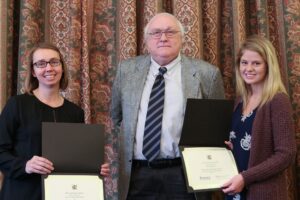
2016 Miles Grant Recipient, A. J. Schwichtenberg, HDFS, supporting Anne Nanninga, PSY
Growing up with Dup15q and Angelmann Syndromes
This grant is available thanks to the Bob L. and Joyce Beery Miles Research Endowment. After seeing the impact a small amount of support can have on the trajectory of a student, Bob and Joyce created the endowment, further committing their ongoing support of undergraduate research at Purdue.
This award recognizes outstanding published research about families conducted by Purdue faculty. The award is open university-wide. Nominated work may come from any discipline, department, or college. Nominated articles must be empirical, peer-reviewed, and published in the previous calendar year, with a Purdue faculty member as lead author. Self-nominations are welcome, and researchers who haven’t received the award in the past three years are eligible.
Featured Burkhart Award Recipients
2017
Post-Adoption Depression: Parental Classes of Depressive Symptoms Across Time
Karen Foli, Nursing
2026
Early-Life Parental Affection, Social Relationships in Adulthood, and Later-Life Cognitive Function
Patricia Thomas, Sociology
Graduate Student Opportunities
The purpose of this competitively awarded internship is to provide graduate students at Purdue with opportunities to learn about mobilizing data to educate policymakers for the benefit of military members, veterans and their families.
A partnership between the Military Family Research Institute and the Center for Families, this scholarship is aimed at supporting graduate students committed to learning about policy and community impact.
This internship will benefit students who have an interest in using data to influence policy and practice, as interns will work with the Measuring Communities project at the Military Family Research Institute to identify and review available data, and participate in preparing user tools and reports to communicate data to decision makers in government, nonprofits and advocacy organizations across the country.
Interns may also have opportunities to participate in relevant conferences. Interns also will have an opportunity to visit Capitol Hill in Washington DC to ‘shadow’ government relations professionals as they engage in policy-relevant activities.
Graduate students must be in at least their second year of study to apply. Interns must register for academic credits to support their time devoted to this work.
How to Apply
All materials listed below must be combined into one PDF file and submitted via the online application process, via the Apply Now button.
- Statement of Purpose no longer than 3 double-spaced pages in which you:
- Provide a summary of your relevant experiences and qualifications
- Explain how this internship will support your future professional goals
- Curriculum Vitae
- Letter of support from a faculty member(s) regarding student’s qualification
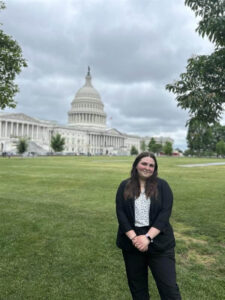
2024 Bay Family Intern, Sybil Cutler, at the United States Capitol in Washington, D.C.
(source: https://www.mfri.purdue.edu/purdue-student-considers-career-in-policy-after-completion-of-bay-family-policy-internship/)
This scholarship is possible due to support from the Bay Family Endowment, created with generous funding from Charles and Laurie Bay, both veterans and Purdue University alumni with strong commitments to helping military and veteran families.
ThisThis grant will support graduate students who are conducting research that addresses family strength, adaptation, and resilience during periods of stress or challenge. Research supported through this funding opportunity will inform new approaches for equipping all families with strategies and resources that prepare them to skillfully navigate adversities and that help them to thrive. Priority will be given to research that addresses challenges faced by military and veteran families, but research proposals that involve all types of family stressors and challenges are welcome.
How to Apply
All materials listed below must be combined into one PDF file and submitted via the online application process, via the Apply Now button.
- Statement of Purpose no longer than 3 double-spaced pages in which you:
- Identify the goals of your proposed project
- Outline your implementation plan (how the project goals will be addressed)
- Explain how this project aligns with the opportunity you are applying for and how it will advance the work of the Center for Families
- Provide a summary of your relevant experiences and qualifications for carrying out this project
- Budget Justification (Describe how you will use the CFF funding to support your project goals)
- Curriculum Vitae
- Letter of support from the faculty member(s) who has agreed to supervise the project work.
Prepare a short abstract that briefly summarizes the rationale and methods for the work you propose, 250 words or less. You will submit this in the online application.
Students may apply for more than one opportunity. Preference is given to those who have not been selected to receive other CFF funding, and/or students who are advised by CFF faculty partners.
This grant is possible through the generosity of Peggy and David Dunlap, who established the Strengthening Family Resilience Grant to support graduate student research focused on family strength, adaptation, and resilience. Their commitment reflects a belief in the power of research to help families navigate stress and adversity and provides emerging scholars with opportunities to advance knowledge that can strengthen families and communities.
This grant supports students conducting research or thesis work that is directly impacting the community with a strong focus on work and family. It will allow graduate students to attend workshops or professional conferences. Recipients must be involved with the Center for Families, the Military Family Research Institute, or they must have a faculty advisor who is a Center for Families faculty partner.
How to Apply
All materials listed below must be combined into one PDF file and submitted via the online application process, via the Apply Now button.
- Statement of Purpose no longer than 3 double-spaced pages in which you:
- Identify the goals of your proposed project
- Outline your implementation plan (how the project goals will be addressed)
- Explain how this project aligns with the opportunity you are applying for and how it will advance the work of the Center for Families
- Provide a summary of your relevant experiences and qualifications for carrying out this project
- Budget Justification (Describe how you will use the CFF funding to support your project goals)
- Curriculum Vitae
- Letter of support from the faculty member(s) who has agreed to supervise the project work.
Prepare a short abstract that briefly summarizes the rationale and methods for the work you propose, 250 words or less. You will submit this in the online application.
Students may apply for more than one opportunity. Preference is given to those who have not been selected to receive other CFF funding, and/or students who are advised by CFF faculty partners.
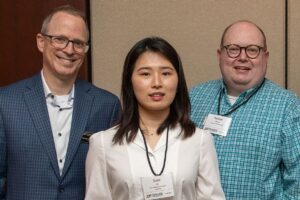
2025 Dr. Shelley MacDermid Wadsworth Graduate Student Research Recognition Grant was awarded to Sumin Im, Public Health Transportation, Time Allocation, and Sleep
This grant is available thanks to the Dr. Shelley MacDermid Wadsworth Graduate Student Research Recognition Fund, created in her honor as recognition of her leadership as the director of the Center for Families.
Awarded approx. every two years, the the McAllister Fellowship supports collaboration between a graduate student and their advisor on research related to the quality of life for families, with a focus on how that work strengthens families and improves their well-being. The fellowship, administered as an assistantship, provides equivalent support to that of a 12-month, .50 FTE graduate research assistant position. McAllister Fellows are considered University employees and subject to applicable policies and procedures, but carry no duties other than completion of the work described in the application. Applicants must have a master’s degree, have completed their PhD qualifying exam, and be a U.S. citizen.
Featured McAllister Fellows
1994
Inaugural McAllister Fellow
Anne Prouty, HDFS
2013
Attachment Behavior and Representation across Early Childhood: Links to Maternal Behavior
Jill Trumbell, HDFS
2025
A La Mesa: Bringing Nutritious, Culturally Adapted Meals to the Family Dinner Table
Ivan Mendoza, HDFS
How to Apply
All materials listed below must be combined into one PDF file and submitted via the online application process, via the Apply Now button.
- Statement of Purpose no longer than 3 double-spaced pages in which you:
- Identify the goals of your proposed project
- Outline your implementation plan (how the project goals will be addressed)
- Explain how this project aligns with the opportunity you are applying for and how it will advance the work of the Center for Families
- Provide a summary of your relevant experiences and qualifications for carrying out this project
- Curriculum Vitae
- Letter of support from the faculty member(s) who has agreed to supervise the project work.
Prepare a short abstract that briefly summarizes the rationale and methods for the work you propose, 250 words or less. You will submit this in the online application.
Students may apply for more than one opportunity. Preference is given to those who have not been selected to receive other CFF funding, and students who are advised by CFF faculty partners.
This grant is for students who have chosen a field of study that combines two or more academic disciplines, one of them being the study of families. It allows them to engage in a program of scholarly activity of their own design, related to the focus of the grant. The work must be supervised by two faculty members in two different departments.
Featured Studorschka Recipients
2014
Preschoolers’ Physical, Social,
and Engineering Play Behaviors:
Differences in Gender and Play
Environment
Zachary Gold, HDFS & ENGR
2015
Bridging the Gap: Examining
Indiana Legislators’ Uses
of Research and the Family
Impact Lens in Policymaking
Elizabeth Day, HDFS & Political Science
2025
End-of-Life Financial
Decision-Making Among Rural
Blacks/African American
Women with Advanced
or Late Staged Breast and
Gynecological Cancers
Evans Osei, Nursing &
Gerontology
How to Apply
All materials listed below must be combined into one PDF file and submitted via the online application process, via the Apply Now button.
- Statement of Purpose no longer than 3 double-spaced pages in which you:
- Identify the goals of your proposed project
- Outline your implementation plan (how the project goals will be addressed)
- Explain how this project aligns with the opportunity you are applying for and how it will advance the work of the Center for Families
- Provide a summary of your relevant experiences and qualifications for carrying out this project
- Budget Justification (Describe how you will use the CFF funding to support your project goals)
- Curriculum Vitae
- Letter of support from two faculty members who have agreed to supervise the project work (Studorschka Grant applicants must provide at least two letters of support from faculty in two different departments)
Prepare a short abstract that briefly summarizes the rationale and methods for the work you propose, 250 words or less. You will submit this in the online application.
Students may apply for more than one opportunity. Preference is given to those who have not been selected to receive other CFF funding, and/or students who are advised by CFF faculty partners.
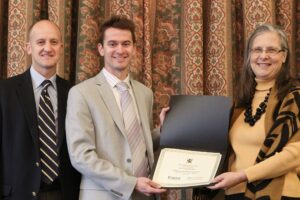
2017 Studdorschka Interdisciplinary Research Grant was awarded to Matthew Perrigino, OBHR, Family supportive supervisor behaviors (FSSB) in organizations
This grant is possible due to the generosity of Dr. Travis Dorsch and Dr. Breanna Studenka and the Studorshka Interdisciplinary Research Endowment. While completing his doctoral dissertation in Health and Kinesiology at Purdue, Travis spent hours learning about families, as he recognized that you can’t study individuals in isolation. He sought out support from the CFF Funding Program, which helped launch his career. He and Bree hope this interdisciplinary grant will help launch the career of others.
Undergraduate Opportunities
For the Research Enhancement Grant, faculty members must apply on behalf of students following the instruction outlined under faculty opportunities. Undergraduates interested in this grant should contact their faculty advisor.
Program Support
This opportunity was established to support Purdue Extension Health and Human Sciences programs that engage directly with communities across Indiana, with the goal of making a meaningful and measurable difference in the lives of families. Recognizing that families are at the heart of strong communities, these grants support applied research, community‑engaged scholarship, and outreach efforts that not only generate new knowledge but also translate that knowledge into real‑world impact.
Through this initiative, those working under the Extension umbrella are encouraged to collaborate with local partners, such as service providers, schools, community organizations, and families themselves, to address pressing challenges that affect family well‑being. Projects funded through this program are expected to build on interdisciplinary strengths, center the lived experiences of families, and contribute to sustainable improvements in areas such as health, education, economic stability, early childhood development, caregiving, and community resilience.
By investing in work that bridges academic inquiry with community practice, this initiative supports Purdue’s land‑grant mission and the Center for Families’ commitment to fostering equitable opportunities, strengthening family functioning, and enhancing quality of life for individuals and families throughout Indiana and beyond.
Annual process
- All available funding opportunities are announced by the end of October each year.
- All applications are due the following February.
- All fellowships, awards, and scholarships are announced by the end of March.
- An annual breakfast is held in April where recipients are honored.
- All recipients submit a report summarizing the work completed during the grant period by April 30 of the following year.